
<<< I’M RUNNING A GIVEAWAY OF NAOMI’S BOOK . . . SEE BELOW >>>
Comment below for a chance to win your choice of an ebook or a paperback—USA only.
“The circus is in town!”
Author Naomi Musch’s new novel, The Girl from Tomorrow’s Town, spotlights the traveling Hagenbeck-Wallace Circus in the early 1900s. It was the second-largest circus after the Ringling Brothers/Barnum & Bailey.
Though the circus in The Girl From Tomorrow’s Town spends more time in Indiana, back in the day, it toured Wisconsin with stops at Manitowoc, Green Bay, Stevens Point, and Eau Claire.
I mention this because Wisconsin has a lot of circus history. Naomi and I both live in Wisconsin—at opposite ends of the state.
After the train tragedy, the Hagenbeck-Wallace Circus received aid and equipment from from the Ringling Brothers. Barboo’s Circus World Museum preserves some of the Hagenback-Wallace history as a traveling show.
Peru, Indiana was the winter headquarters for several circuses, including the Hagenbeck-Wallace Circus. Peru was known as the “Circus Capital of the World” for decades.
Naomi has been a guest on the blog before:
- June 18, 2024—Polly (Apron Strings series)
- August 6, 2024—The Deepest Sigh
- October 7, 2025—Courting the Country Preacher
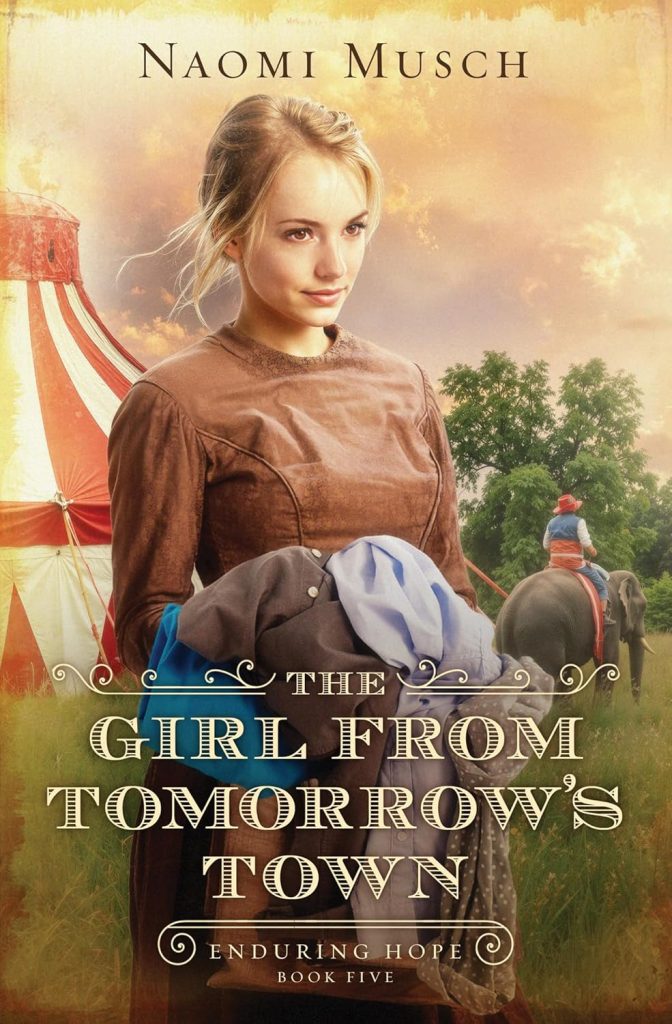
Blurb for The Girl from Tomorrow’s Town (Enduring Hope series)
Past and Present Collide on the Railway
When life seems weighed down by challenges, there are always pillars of enduring hope and love to be discovered.
Lily Mae Dodge flees Wyoming by night to find her mother, who sent her west on an orphan train ten years ago. After she’s arrested in Chicago, help comes from a man with a rare vision impairment whom she only just met on a train. Francis Basnett is a roustabout for the famous Hagenbeck-Wallace circus, where he helps Lily gain employment. Their friendship grows into more, and it seems Lily is closer than ever to finding her mother. . .until the night a rogue troop train slams into the stalled circus train, killing dozens and splintering hope.
***********************
My thoughts:
Naomi honored me by asking me to endorse her book.
Here’s my official endorsement:
“When Lily Dodge describes color to legally blind Francis Basnett, she presents pink as ‘the first breeze on a summer morning, tingling up your arms with the dawn.’ These words perfectly describe The Girl from Tomorrow’s Town. Though wrought with heartache, tragedy, loss, and longing, this tender love story affirms that grief doesn’t get the last word. Lily is a heroine to root for, and Francis a hero to admire. His visual impairment doesn’t prevent him from possessing deep insight into ways of the heart. Beautifully written, Naomi Musch’s immersive tale transports you from Wyoming to the Midwest, from doubt to faith, from rejection to acceptance in a true home, and from discord to harmony as joyous as the Big Top.”
Join me for some Q & A with author Naomi Musch.
<<< I’M RUNNING A GIVEAWAY OF NAOMI’S BOOK . . . SEE BELOW >>>
Comment below for a chance to win your choice of an ebook or a paperback—USA only.

What was your inspiration for writing The Girl from Tomorrow’s Town? What’s your personal connection to the story and/or setting?
Naomi: I have long believed that one of the best ways to understand history or care about it, is to read biographical or documented historical accounts, certainly, BUT ALSO to read a story that immerses a fictional character into the historical event. Historical fiction helped me to fall in love with actual history and want to learn more.
Because of that love of history, I was searching for a story idea that might involve a large number of people in a lesser-known historic tragedy. There are segments in our world’s past events that make us sigh with the regret over what happened and move on.
However, when we look at the stories of those who lived through those events with a close-up lens—even through the eyes of a fictional character able to transport us there—we develop an even deeper empathy and understanding of that time and event.
While I enjoy writing in various periods of American history, one that really strikes me is the early 20th century and WWI era. I seek to focus on the Midwest when I can. So, when I learned about the 1918 great Hagenbech-Wallace circus train wreck in northern Indiana, I just had to dig deeper.
What a great starting point for digging into history! How did you develop your hero and heroine? Did they hijack the story or did you have full rein?
Naomi: In 1918, when the story takes place, there are changes going on everywhere. It’s such a rich period to glean from. For instance, both cars and horse-drawn wagons roamed the streets. Steel cars ran the rails, but the circus train was still using wooden cars. War and shortages had fashions in flux. Manpower was scarce, but jobs were plentiful.
Interestingly, another facet of history at this time was that there were still orphans and street urchins being sent west on the orphan trains. The fact that my heroine grew up as one of those children immediately gave her a huge backstory that was fun to develop, and it presented the crux of the first story goal—to find “home”.
In my research of the period, I also stumbled upon a little known-about and rare form of color blindness combined with another sight condition that I gave to my hero. It was his reason for not being involved in the war, and it put him in the path of my heroine. His condition also added a layer of difficulty to what happened to both characters after the train crash.
I would not say that either character hijacked the story, but they were fun to develop—from their own backstories to the way those backstories shaped their goals and dreams.
You certainly included a variety of aspects characterizing that time period. Which character presented the biggest challenge and why?
Naomi: My hero was the biggest challenge to write, because of his eye condition. I had to do a great deal of research. Since I myself have relatively good eyesight, I needed to dig heavily and empathetically into what it might be like to have forms of blindness, and I needed to place myself deeply into my hero’s emotional and mental point of view, as well as the physical one, especially since he worked in the world of the circus, and because of his experiences in that terrible train accident.
Your research served you well. You did an amazing job writing from his point of view in the story. Did the plot stick to a pre-determined plan or did it evolve? Explain.
Naomi: I’m a plotter, so my story basically stuck to a plan. When I pitched the initial idea to my publisher (Barbour), I needed to give them a general synopsis of what I envisioned of the story. When they decided to contract the book, it was up to me to keep my promise in the follow-through, with some allowable (and expected) creative variation, of course.
There are always changes that occur when writing a novel. A novelist can’t completely envision a book from beginning to finish, no matter how much of a plotter they are.
So, there were things that came up I hadn’t imagined until they emerged from the developing story, and there were characters I hadn’t fully fleshed out until I realized they were going to step on stage and need a story of their own to make them come alive. Also, there were some changes made when I discovered further historical details during my research.
Ah, the bliss of writing! You truly never know what’s coming next no matter how well you plan. What was the hardest scene to write? Why?
Naomi: The hardest scene to write was the circus train crash and the hours surrounding it. Timing of the day for the individual characters was important. Furthermore, it was emotional, and I wanted to treat it respectfully since it involved so many real (historical) people. In the telling, I write about a number of real as well as fictional victims, and I want to honor the memory of those who lived and still have descendants today.
Your portrayal of that event indeed did honor those involved. What unusual or interesting thing did you do or discover while researching for this story?
Naomi: Stumbling upon the hero’s vision problem—called achromatopsia, coupled with nystagmus—made my mind leap with the novel plotting possibilities. I began researching the life of achromats, people born with this rare condition that is truly blind to color, seeing the world only in black and white. Their vision behaves something like a reversed negative. Acromats are also sensitive to bright light and actually see slightly better in dim lighting or darkness.
However, very little was known about achromatopsia in the early part of the twentieth century, and really, the research is only recently improving. So, my mind went into that world of what difficulties someone like that might have faced over a hundred years ago.
Nowadays we can learn more quickly, with help from online platforms like YouTube and medical journals, it’s easier to find out how people live with these and other unusual conditions.
But to put myself into the shoes of someone over a century ago—in the dazzling and sometimes chaotic world of a circus, no less—and to add to that a fiery train crash that would bring mayhem to everyone involved . . . why, that just intrigued me to no end. I had to make that happen.
You did an great job putting yourself into Francis’s shoes. If a reader could underline only one passage, which would you choose—and why?
Naomi: That’s a tough one, but I think it would be this one, when Lily is filled with questions and sorrow and another character speaks truth to her:
“We live in a fallen world, Lily. A sin-cursed, fallen and broken world. God didn’t promise to remove our suffering while we’re here, but he will be the lap we can climb into while we go through it. He will hold us and love us through. He’ll give us peace.”
I am also going to tell you about a line that resonated with an early reader who happened to be blind (unbeknownst to me at the time). She said she loved how the heroine used other senses to describe color to the hero, because the reader herself had trouble understanding color. She particularly liked this:
“Pink is the first breeze on a summer morning, tingling up your arms with the dawn. Or it’s when the first rose of springtime—a light one, but not quite white—opens its bud and spreads its petals, and you want to inhale it. Have you ever smelled a wild rose?”
“Yes. Delicious.”
Those descriptions captured me too. How lovely that it touched your reader who is blind. How do you want this book to resonate with readers?
Naomi: First, I want readers to feel swept into the story. I want them to go to a place where everything drops away and they are pulled in to the lives of my characters. I want them to be entertained.
But every now and then I want a nugget to rise up to a conscious level that will make them say to themselves, “That’s how I feel. I understand exactly what this character is going through.” Or to think, “I’ve never looked at that experience that way. I’ve never thought of that.”
I want them to recognize any truths in the story that God might be offering their hearts.
I know for myself, when I read a novel that resonates with me, it’s usually that a spiritual truth is being revealed through a character or situation. Not preachy or pushy, but in the way a flower bud opens. That’s the stuff that reduces me to tears or laughter.
Finally, I hope that the historical context of the stories I write will bring history to life for readers in a way that they haven’t seen it before. I didn’t think I liked history back when I was a student in high school.
Then I realized it was because history books didn’t give me good context by showing it to me through the personal lives of people who experienced it. I want people to read my stories and feel like they’ve lived in them, during that time, at least a little.
Absolutely! Again, the best way to learn history is through the eyes of people—fictional or not—who lived it. Which of your books is the best introduction to you and your work?
Naomi: Oh, that question makes me laugh, because I don’t think my answer is ever the same from one year to the next. I always thought that maybe The Deepest Sigh was a quintessential introduction, but Mist O’er the Voyageur lived in my heart for years before I wrote it, and even after a decade it is still very close to me.
Now I think that this current work, The Girl from Tomorrow’s Town, really does introduce new readers to my style and the themes that echo through my soul in a well-rounded, lovely way.
Reading tastes being subjective, I will have to defer to those searching through my various novels to find the one that sounds like it would be their cup of tea, and I’m always happy to hear what they think.
<<< I’M RUNNING A GIVEAWAY OF NAOMI’S BOOK . . . SEE BELOW >>>
Comment below for a chance to win your choice of an ebook or a paperback—USA only.
***************************
Back to Laura . . . On a similar note . . .
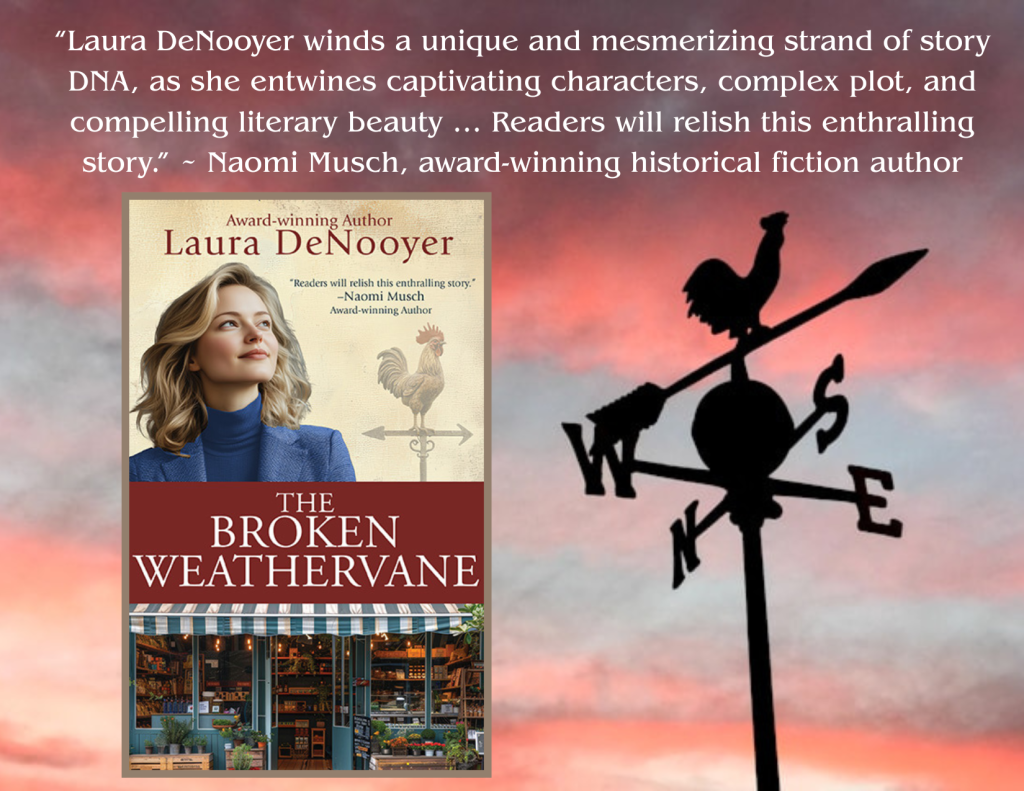
If you like dual timeline fiction about family dynamics in a small town Midwest (Wisconsin) setting, try The Broken Weathervane (launched September 2). Two co-workers seek the same information. One wants to publish it; the other has good reasons to keep it hidden. The timeline alternates between 2015 and the 1950s. Check out the reviews and book trailer here.
Here’s what Naomi said about The Broken Weathervane:
If you like historical fiction, you might enjoy A Hundred Magical Reasons (launched January 2025). This story spotlights L. Frank Baum, author of The Wonderful Wizard of Oz, his friendship with a young girl, and his impact through the decades. Set in Holland, Michigan, this dual timeline novel alternates between 1980 and the early 1900s. Read more and watch the book trailer here.
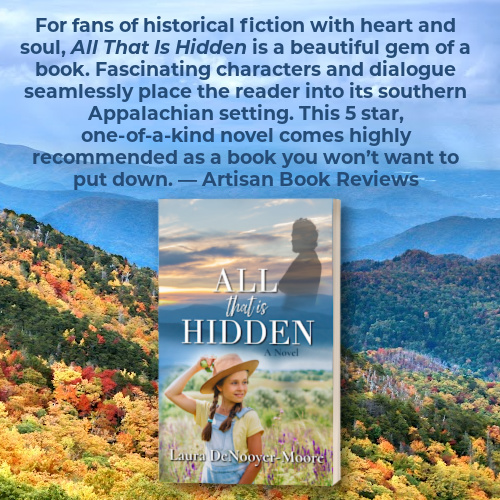
If you like Southern fiction and small town/rural stories about family dynamics and secrets, you might enjoy my novel All That Is Hidden. Set near North Carolina’s Smoky Mountains in 1968, the story spotlights the bond of family and the connections of a tight-knit community. Northern exploitation threatens as a father’s hidden past catches up to him and tests family ties. Learn more and watch the trailer here.
All That Is Hidden is now an audiobook!
I invite you to join my monthly newsletter for writing updates, freebies, and giveaways. Sign up and I’ll send you a prequel and 7 Oz-inspired recipes: StandoutStoriesNewsletter.com
*************************
Naomi Musch bio:
Naomi Musch is a multi-award-winning author, most recently with a 2025 silver Carol Award for her novella The Angel and the Sky Pilot, in Barbour’s Courting the Country Preacher collection. Shewrites to bring hope that will change the story—maybe even her own. Naomi is at home in the Wisconsin Northwoods where her perfect day is spent writing, and might include roaming her family’s deer ranch, plundering the garden, relaxing in her vintage camper, or kayaking a nearby lake with her husband Jeff. Most especially, she enjoys loving on her family and passel of grandchildren. Learn more on her website NaomiMusch.com.
**********************
Join me next time for a visit with author Crystal Caudill.
Meanwhile, have you read The Girl From Tomorrow’s Town or any of Naomi’s novels, fiction with a circus setting, or historical stories set in the Midwest you’ve enjoyed?
Answer in the comments below for a chance to win one of Naomi’s books.
Ever reading,
Laura
Sign up for my monthly newsletter and receive a prequel and 7 free Oz-inspired recipes: StandoutStoriesNewsletter.com





Sounds interesting! Thank you!
I hope you get to read it, Bridgette! Thanks for dropping by.
Naomi’s book sounds intriguing!
I hope you get to read it, Maureen!
Thanks, Maureen! It was really fun researching the story.
Thanks for taking a look, Bridgette!
I would love to read Naomi’s new book. This is especially fascinating to me as I am currently reading P. T. Barnum’s autobiography as well as a number of books about circus history. Her description of the color pink is lovely! I can feel and see that. Thank you, ladies, for this interview and for sharing it.
With all your interest in circus history, this would definitely be a great story for you to read!
Cathy, thanks so much for popping in! I bet the Barnum autobiography is really interesting. Researching the various circuses traveling around the country in their heyday was quite a deep dive that I truly enjoyed. God bless!
From the hero’s eye condition to the circus and the train crash, The Girl from Tomorrow’s Town sounds like a fascinating novel! The description of the color pink is beautiful!
Yes, besides the train crash, the hero’s condition gives this story an extra layer for sure.
Thank you so much for that comment, Nancy! It’s such a fascinating time period. So many interesting details and ideas to write about. God bless!
I have greatly enjoyed every book I have read by Naomi. Her writing style brings the settting, characters, and action to life, and I feel as if I am there. The Girl from Tomorrow’s Town sounds outstanding. From the descriptions and interview, I know that reading it will,be an immersive experience.
Yes, it’s definitely an immersive experience!
Thank you so much for the kudos, Roxanne. That really encourages me. I hope yo get a chance to read it and enjoy it!
The circus setting is a draw for me. This past year I’ve read two books set in a circus. The hero’s eye condition is interesting and not something typical of a main character. The orphan train is fascinating to me, as well. I’ll need to read this book in the future. I’ve enjoyed some of Naomi Musch’s writings in the past.
So glad you’ve enjoyed Naomi’s previous books. Yes, this one is a unique combination of features.
Thanks for dropping by, Mary! I never imagined myself writing a circus story, but it was fascinating research, and then learning about the type of blindness that is portrayed in the story just made another great twist to write about. Dovetailing into the orphan train history. . .well, it was a period full of rich storytelling fodder.
Wow! What a unique and intriguing amalgam of story lines!
The orphan train, the circus culture and rare medical condition.
And it sounds as though they all come together beautifully!
Yes, Naomi does a great job of dovetailing all these things into one cohesive story!
Thanks, Anita. Yes, so many discoveries while I researched and plotted made it easy to build the story and the characters’ histories. It’s funny how it feels like a jumble of information when I begin, and then it slowly irons out into a story I can’t wait to tell. Blessings!
I haven’t read any yet. It looks like a good book.
Thanks for popping in, Leela! I hope you get a chance to try it out. It’s also on audio.