<<< I’M RUNNING A GIVEAWAY OF CRYSTAL’S BOOK . . . SEE BELOW >>>
Comment below for a chance to win a signed paperback of Sung in the Shadows—USA only.
Suspense is not my go-to genre but periodically I read one and am glad I did. Such is the case with Sung in the Shadows by Crystal Caudill. Part of what drew me to read it was the aspect of mental illness, a topic of interest. The heroine’s mother is in the asylum for presumed paranoia where the hero’s mother is a patient due to melancholia (what we now call depression) and suicidal attempts (trigger warning).
But this is not just a tale of woe and gloom. It’s a story of faith, hope, and courage.
Additionally, it’s a comparable title to my book, The Broken Weathervane (September 2025), which also deals with mental illness. So, I was intrigued when I learned Crystal’s story had similar themes. I wanted to see how she incorporated them.
Furthermore, I’ve enjoyed a couple of Crystal’s previous books and knew I was in for a great story. Counterfeit Love and Written in Secret are both compelling and well written.
She joined me on the blog in 2022 for her debut novel, Counterfeit Love.
Though Sung in the Shadows is book two in the Art of Love and Danger series, it can be read as a standalone.
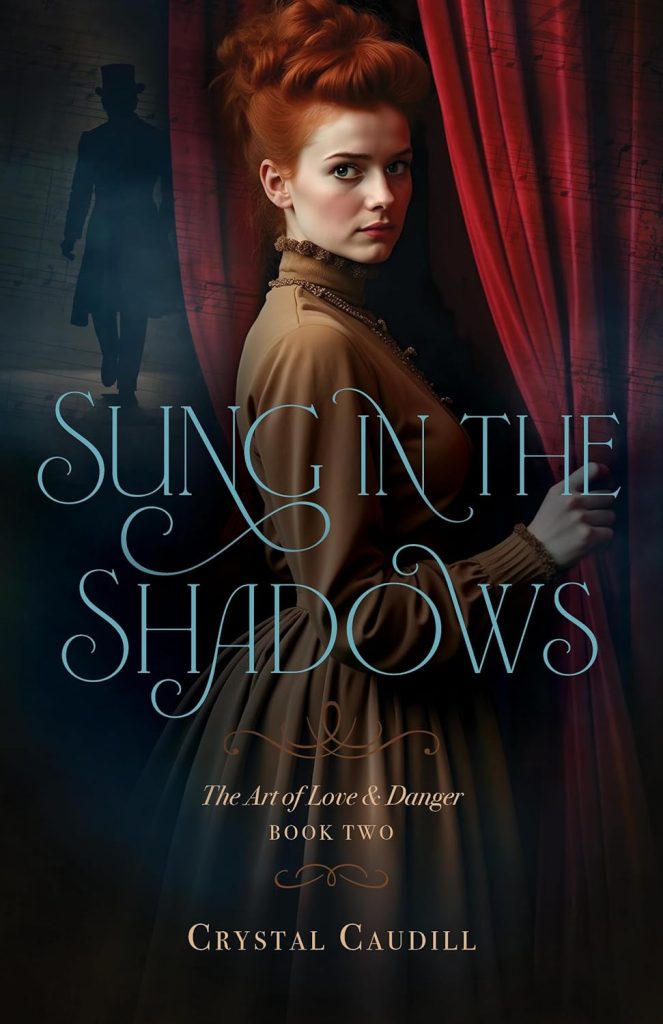
Blurb
When past darkness prowls, will stepping into the light lead to a brighter future?
In nineteenth-century Cincinnati, fear keeps Nora Davis caged with secrets and lies. Her true identity as the daughter of a famous opera singer is too dangerous to reveal with her former captors still on the loose. But weekly singing lessons at Longview Asylum—her paranoid mother’s permanent residence—light a flame in Nora, and it’s one she can avoid fanning for only so long.
With his suicidal ma in the asylum, Ezekiel Beaumont’s soul is weary, but Nora’s presence at the asylum intrigues him. As a Pike’s Opera House employee, Ezekiel thinks Nora might be cut out for the stage. He also begins to wonder if Nora’s ma is really the famed Constanza Brisbane, who went missing mid-performance. He’s determined to find out.
Though Ezekiel brings the performance world a little too close for comfort, Nora is drawn to his warm personality all the same. The two of them steadily grow closer, but then Nora begins to fear she’s being watched, and her own paranoia blooms.
As the line between what’s real and false grows fainter, will Ezekiel’s and Nora’s faith and love overcome?
*******************
My thoughts
I appreciated Crystal’s sensitive and respectful handling of Constanza (Nora’s mom) and Mrs. Beaumont (Ezekiel’s mom). Their treatment in the asylum was horrifying—often administered without love, understanding, or empathy—but true to the time period. In general, folks’ view of the mentally ill was dismal, to say the least. On top of that, mental illness was considered hereditary, inflicting even more fear.
Mark (Nora’s dad) would claim the anonymity and silence he enforced was for the family’s safety. This begs the question: how much should safety trump truth? The entire family is living a lie. Constanza is in misery, and Nora lives with squashed dreams of singing and performing. According to her dad, it’s too dangerous to resume their previous life or have any ties to the opera. Which is likely true, but . . .
Since the Davis family goes by new names, I thought everyone’s identities would be confusing, but it wasn’t. The confusing part, though, is discerning what’s true and what’s not—which adds to the tension and keeps the pages turning. Nora has never been told all that transpired prior to her kidnapping, and why the kidnappers sought her and her mother. That puts her former captors at a distinct advantage when they come calling again.
Thank goodness for comic relief in the form of the Guardians—Nora and her three friends Lydia, Flossie, and Theresa. As Lydia’s fiancé Abraham advises Ezekiel, one must take a particular remedy for indigestion whenever dealing with those ladies’ unconventional antics. The four Guardians are hilarious together—and very invested in romance blooming.
Besides the chapters alternating between the hero and heroine as in a typical romance, some scenes are shown through Nora’s mom’s point of view. Depression, anxiety, and other mental illnesses are no respecter of persons, whether Christian or not. I appreciated the way Crystal dealt with this. First, I loved seeing the care and concern Nora and Ezekiel had for their mothers. They were dedicated to visiting them weekly, whenever allowed.
Secondly, Nora eventually realizes you can only do so much to protect your loved ones. You can’t save them from themselves and their own bad choices. She says:
“We can do everything right and it still not be enough.
Only God is enough, even though sometimes it doesn’t feel like He is.
I don’t understand why He is allowing this. It feels wrong and unjust.
I’m angry with Him, and I’m scared of what the future holds.
I don’t want this burden He’s given us, but I know it’s not our fault.
I know it’s not our job to save them.” ~ Nora
There are no pat answers when it comes to mental illness. No easy solutions. There’s much pain and sorrow even while holding onto God. Ezekiel offers additional insight:
“Hiding your pain and thoughts doesn’t make you a stronger person.
It makes life lonelier to walk through.” ~ Ezekiel
Though some scenes are hard to read and the ending happens a bit too quickly (in my opinion), I highly recommend this story with its strong faith thread resolving in hope.
Join me for some Q & A with author Crystal Caudill.
<<< I’M RUNNING A GIVEAWAY OF CRYSTAL’S BOOK . . . SEE BELOW >>>
Comment below for a chance to win a signed paperback—USA only.

Questions about Sung in the Shadows
What intrigues you most about this time period? What elements did you want to include from the get-go?
Crystal: I love how layered the Gilded Age is. Most people think of all the glitz and grandeur of the uber rich of the time, but what I love is scraping beneath the gilded frame (as Mark Twain suggested) to find the rotten hearts, duplicity, and harshness of life that they wanted to pretend didn’t exist.
Mental illness and asylums were two of the topics the Gilded Age wanted to say they were championing, but when you looked deeper, asylums were horrible places where vulnerable people were taken advantage of and hurt.
The moment I knew mental illness and asylums were going to be part of the story, I wanted to give an accurate portrayal of society’s view of and aversion to those who struggle, as well as what asylums were more often like than not. As with most things, asylums started out with good intentions, but the result was horrific.
Frankly, I prefer reading about “real” people rather than glitz and glamour. How well did you know your key characters at the beginning of the novel, or did you get to know them as you wrote? How did they evolve?
Crystal: I have a generally good idea of who my characters are in a story before starting, but as I write, they grow and develop into their own people separate from what I actually planned.
Nora is lightly modeled after one of my friends, so that helped, but her struggle with caring for a mother with mental illness and her fear of ending up with the same or a similar mental illness came from personal experience. Still, Nora ended up her own person.
And Ezekiel? That man ended up being way more of a flirt than I expected. LOL
It’s funny what those characters will get away with if you let them! Which character presented the biggest challenge and why?
Crystal: Nora’s mother lived in the asylum for her entire point-of-view chapters. Writing the mind of someone who struggles, has secrets, and is wrestling to find faith . . . that was really hard.
I wanted an accurate picture that is not degrading, but allows those who have never dealt with mental illness have a glimpse into that life and grow compassion and empathy for them. That is a hard balance to strike.
I commend you for tackling that challenge. What was another big challenge in writing this story?
Crystal: Writing the opera world in a realistic way. Thankfully, I had an amazing editor who has a daughter who works in the opera world. Without them, this story would have been so riddled with mistakes and misperceptions, I would have been mortified.
Sometimes you just don’t know what you don’t know. This was the case for me and ended up in some serious rewrites and multiple rounds of serious edits.
While writing this story, I hated it. I didn’t want to deal with the emotions of my own history with caring for those with mental illness, nor did I feel confident that I was getting the story correct. It’s a miracle it turned out the way it did. All to God’s glory.
I’m glad you stuck with it and that you had knowledgable people who could speak into the story that way. What research rabbit hole did you fall into, and what fascinating detail made it onto the page?
Crystal: In order to better understand the opera world, I read several biographies, but my favorite was The Improbable Adventures of Emily Soldene. Much of her life story inspired and made its way into Nora’s mother. I even had Emily Soldene’s opera troupe make an appearance in the story because they really were in Cincinnati at the time of my story. That was great fun.
Sounds like perfect timing! If a reader could underline only one passage, which would you choose—and why?
Crystal: If I could have them just read one page, it would be the page this passage comes from, just so you have the full context. They’re talking about Mathew 11:30, “For my yoke is easy, my burden is light.”
“I know His Word is true, but those verses feel like a lie. This burden is so heavy, and there is no rest from it.” The weight of her anguish pushed free a fat, rolling tear.
He brushed it aside with his thumb. If only he could as easily wipe away the hurt and fear in her eyes. He dropped his hand and reclaimed hers. “Pa taught me those verses, and he spoke a lot about yokes. What do you know about them?”
Her shoulder rose in a one-sided shrug. “It’s a wooden beam across an ox’s neck.”
“Yes, and it generally connects a pair of oxen, allowing them to pull the load together. It doesn’t remove the load, but it makes the burden easier to bear because they share it. The yoke also allows the farmer to control and direct the movements of the oxen while they work. Pa said God never promised to remove the burdens of our lives, but to bear that burden with us and to help guide and direct us through it. Maybe Jesus has paired us under the same yoke so we can share each other’s burdens as He guides us through this mess of life.”
No matter what the reader is facing, I hope that they will cling to all the nuances of that verse that Ezekiel talked about. We are not walking alone. Jesus is with us, guiding us, bearing the burden with us, and sometimes yoking us with others so they also can help us bear the burdens of life. That right there is my passion in a nutshell.
Such an important reminder—something we need to KNOW even when we don’t FEEL it. How do you want this book to resonate with readers?
Crystal: I want readers to feel seen. Especially those who are caregivers for those with mental illness or those struggling with mental illness. It’s a very lonely world, and we feel misunderstood, ignored, or even suffer prejudice for it.
I’ve now walked both sides, and I want to be a voice for the voiceless, and hope. May they see hope, feel it, and cling to it. May those who have never had to be on either side of mental illness walk away feeling like they understand others and have better compassion for them.
Amen! Which of your books is the best introduction to you and your work?
Crystal: Counterfeit Love was my debut book and is still one of the best intros to my work. Not only will the writing only get better from there (I hope), but there are two series, both connected by Theresa in Counterfeit Love.
<<< I’M RUNNING A GIVEAWAY OF CRYSTAL’S BOOK . . . SEE BELOW >>>
Comment below for a chance to win a signed paperback—USA only.
***************************
Back to Laura . . . On a similar note . . .
If you’re intrigued by characters with mental illness and family dynamics, try The Broken Weathervane (September 2, 2025). Two co-workers seek the same information. One wants to publish it; the other has good reasons to keep it hidden. The timeline alternates between 2015 and the 1950s. Check out the reviews and book trailer here.
If you like historical fiction, you might enjoy A Hundred Magical Reasons (launched January 2025). This story spotlights L. Frank Baum, author of The Wonderful Wizard of Oz, his friendship with a young girl, and his impact through the decades. Set in Holland, Michigan, this dual timeline novel alternates between 1980 and the early 1900s. Read more and watch the book trailer here.
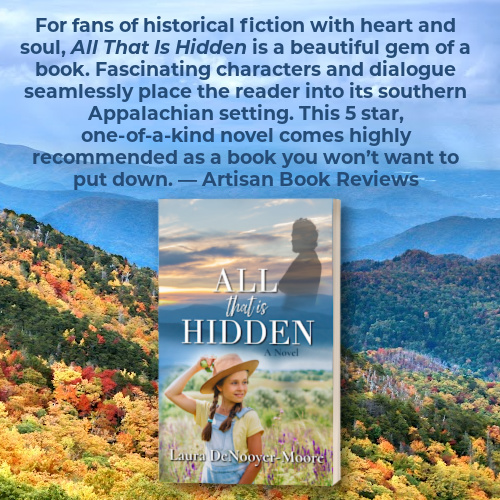
If you like Southern fiction and small town/rural stories about family dynamics and secrets, you might enjoy my novel All That Is Hidden. Set near North Carolina’s Smoky Mountains in 1968, the story spotlights the bond of family and the connections of a tight-knit community. Northern exploitation threatens as a father’s hidden past catches up to him and tests family ties. Learn more and watch the trailer here.
All That Is Hidden is now an audiobook!
I invite you to join my monthly newsletter for writing updates, freebies, and giveaways. Sign up and I’ll send you a prequel and 7 Oz-inspired recipes: StandoutStoriesNewsletter.com
***********************
Crystal Caudill bio:
Crystal Caudill is the author of “dangerously good historical romance.” Her debut novel, Counterfeit Love, was a 2023 Carol Award finalist, and her novella, “Star of Wonder,” won the 2024 Christy Award for short form. She loves history, hot tea, all things bookish, and the Teenage Mutant Ninja Turtles. She is a stay-at-home mom, caregiver, and chaos organizer. When she isn’t writing, Crystal can be found hanging with her family and playing board games at her home outside Cincinnati, Ohio. Find out more at crystalcaudill.com.
**********************
Join me next time for a visit with author Sarah Hanks.
Meanwhile, have you read any of Crystal Caudill’s novels or other Gilded Age stories of romantic suspense?
Answer in the comments below for a chance to win a signed paperback—USA only.
Ever reading,
Laura
Sign up for my monthly newsletter and receive the 7 free Oz-inspired recipes: StandoutStoriesNewsletter.com




Yes, I’ve read some of Crystal Caudills’ books and so far they’ve been fabulous reads. I enjoy reading books that have some mysterious elements added to them and keep me guessing through their stories.
Yes, Crystal’s stories definitely keep you guessing!
I don’t remember, I think I have one of her books.
Sung in the Shadows interests me on many levels. The time period the story is set in is fascinating with the many contrasts in the world in that era. Also, in researching family history, I came across a wife of an ancestor who, after the birth of her daughter and death of her husband, lived from the age of 35 to 55 in an asylum. Her story has intrigued me. Plus, the ongoing need to approach mental health without stigma is essential. Sung in the Shadows is definitely a story I want to read!
Oh, my! What a terrible thing to find out about your ancestor’s wife! Twenty years in an asylum … I’d be curious about her story too. And her daughter’s.
“Sung in the Shadows” sounds like a very interesting book on a subject that you don’t really see that often in fiction. When I was a child, I had an aunt by marriage that had mental illness. When she would get really bad, my uncle would take her to the hospital where they would receive shock treatments to get her back to normal again. I always thought that would be quite terrifying!
That does sounds horrifying, Joy! So sorry that was going on with your aunt. It must have been scary to know about it as a child. It sounds like she did improve, though, so the treatments helped.
What a unique merger of worlds: that of mental illness and asylums, of, the opera, and of the Gilded Age.
I can imagine the medley of emotional commitment to writing each world—the enjoyment of “living” in an exciting tera, the professionalism required for extensive research, and the burden of portraying such a sensitive topic as mental illness.
And doing it all from the worldview of a believer! Very impressive!
Yes, it is quite the mix of “worlds” and emotions!
Although horrifying, the focus on a POV character in treatment in an asylum is really interesting. Adding in the opera singing is a unique twist. Sung in the Shadows is definitely an intriguing novel!
Intriguing is the right word for it!
I haven’t read any.
I hope you get to sometime!
Sounds like a great story–both dealing with hard circumstances and issues while adding care and humor where there can be. I think mental illness is one of the hardest things to comprehend, even in the Christian community, trying to process how/why the Lord allows some of it. It’s such a hard path for those living it and those who love them. Laura, I know your book Broken Weathervane handled it with compassion. Sounds like Crystal’s does as well!
Thank you for your kind words, Elizabeth. Regarding Crystal’s book, she also handles the tough parts of the story with great care and compassion. She interjects humor and romance in the appropriate places as a way to offset the heaviness.
Crystal’s book sounds so good! I think I’ve only read Crystal’s subscriber freebie and I remember loving her writing and the story. She’s also a friend. 🙂 I’d love to win her novel!
Then it’s high time you read one of her books, Deena! I hope you get a chance soon.